Bangkok traffic is not something you want to underestimate. At the wrong time of day, a short ride across town can turn into a very long story. The good news is that you rarely have to sit in it. Between Skytrain, subway, Grab, taxis, and the occasional slightly questionable motorcycle decision, it’s actually pretty easy to get around once you figure out what works. This is how I usually do it.
BTS Skytrain
If you’re staying anywhere near Sukhumvit or Silom, the BTS Skytrain will quickly become your go-to way of getting around. It runs on elevated tracks above the traffic, which means no gridlock and no sitting in a hot taxi. Just fast, air-conditioned transport that gets you where you need to go.
The BTS has two main lines, the Sukhumvit Line and the Silom Line, and it covers most of the areas visitors spend time in, including Siam, Asok, Thonglor, Mo Chit, Silom, and Chitlom.
To use the BTS, you either buy a single journey ticket from the machines or use a Rabbit Card. The Rabbit Card is a rechargeable smart card that you tap in and out with, instead of buying tickets each time. If you’re staying a few days and plan to use the BTS a lot, it’s worth getting one just for convenience.
You can’t tap in with a credit card or your phone. Payment is either tickets or Rabbit Card.
Fares depend on distance and typically range from around 17THB to about 62THB. A ride from Thonglor to Siam is usually around 35–40THB.
The BTS connects with the MRT at several stations, but the systems are separate, so you’ll need a new ticket or a different card when you switch.
MRT Subway
The MRT is Bangkok’s subway system, and in some parts of the city it’s just as useful as the BTS, sometimes more so. The Blue Line is the one you’ll use most. It’s a loop line connecting key areas like Hua Lamphong, Chinatown at Wat Mangkon, Sam Yot for the Grand Palace area, Silom, Sukhumvit where you can switch to the BTS at Asok, Chatuchak Park, and Bang Sue.
If you’re heading to Chinatown or Chatuchak Weekend Market, the MRT is often the easier option.
To use the MRT, you buy a single journey token from the machines or use a stored value MRT card. You tap in with the token and insert it when you exit.
You can’t use the Rabbit Card here, and you can’t tap in with a credit card or your phone. Even though the MRT and BTS connect physically, they operate separately, so you pay again when switching between them.
Fares are very reasonable, typically around 17THB to 45THB depending on distance.
The trains are clean, heavily air-conditioned, and usually feel a bit calmer than the BTS during rush hour.
Grab
Uber no longer operates in Thailand. Grab is the app you need. I always use Grab when I don’t feel like taking the train. You avoid the whole meter discussion, you don’t have to explain where you’re going, and you see the estimated price before confirming. It’s more expensive than a regular taxi, especially during rush hour or heavy rain, but still inexpensive compared to what you’d pay for a ride in the US or Europe. Grab also offers GrabBike if you’re comfortable riding on the back of a motorbike. Download it before you arrive, connect your card, and you’re set.
Bus
Bangkok has an extensive bus network, and it’s very cheap. That said, it can be confusing if you don’t read Thai, and routes are not always obvious. I rarely take the bus unless I’m in the mood to explore and don’t mind possibly ending up somewhere slightly unintended. Google Maps does a decent job with bus routing now, but it’s not my first choice if I’m on a schedule.
Motorcycle Taxis
Motorcycle taxis are by far the fastest way to cut through Bangkok traffic, but they are not for the fainthearted. The drivers wear orange vests with numbers on the back and wait at designated stands at the entrance to most sois. For short rides within a neighborhood, prices are usually fixed. For longer rides, agree on a price in advance unless you book through GrabBike. Helmets are required by law. Many locals skip them, but you shouldn’t. Some drivers carry a spare helmet, some don’t. If they don’t, find another driver.
The drivers are experienced and know exactly how to weave through traffic, but you’re still sitting on the back of a motorbike in Bangkok traffic, so you’re very exposed. Accidents do happen. Also check your travel insurance in advance, as many policies exclude motorcycle accidents.
Taxi
Metered taxis are still inexpensive in Bangkok. The base fare starts at 35THB, and the meter increases depending on distance and time. You can hail a taxi directly on the street. If the red light in the windshield is on, it’s available. Always insist on the meter. Fixed prices are almost always higher.
It helps to have your destination saved on Google Maps or written in Thai, as some drivers may not know smaller streets or boutique hotels. From the airports, use the official taxi queue. You’ll pay the metered fare plus a 50THB airport surcharge and any tolls. Drivers often don’t carry much change, so smaller bills are useful.
Tuk Tuk
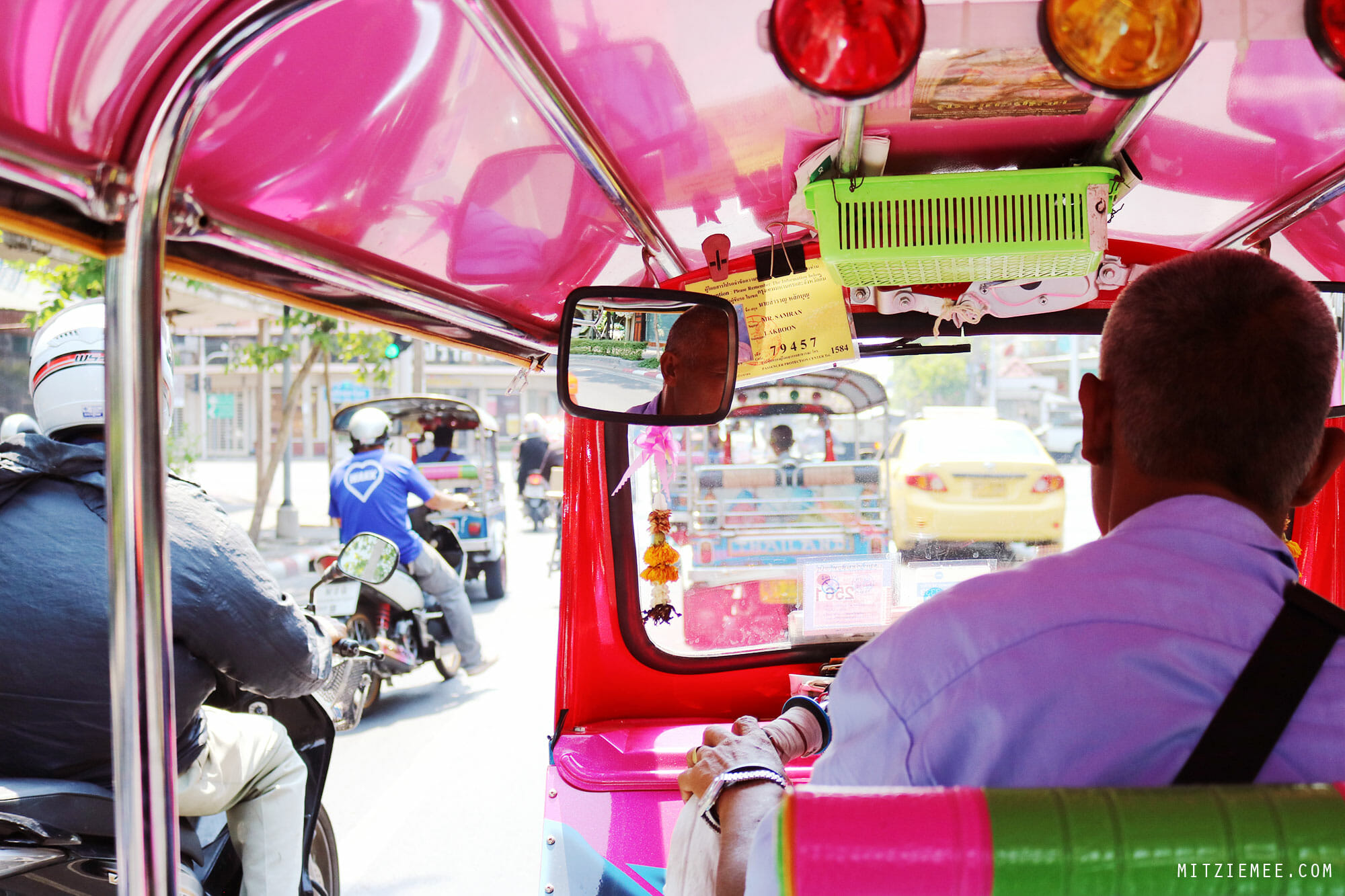
You either love them or you don’t. These days, tuk tuks in central Bangkok are used mostly by tourists. Locals generally stick to BTS, MRT, taxis, Grab, or motorcycle taxis, which are cheaper and more practical. Tuk tuks are noisy, open air, and not particularly comfortable, but they are undeniably part of the Bangkok experience. You’ll find them clustered around tourist-heavy areas like Khao San Road, Chinatown, and the Grand Palace.
The price is negotiated in advance and rarely cheap. In most cases, a metered taxi or Grab will be more comfortable and less expensive. If the ride seems unusually cheap and includes special sightseeing stops, be cautious. Some drivers receive commission from gemstone shops and tailors and may try to steer you there. If you want to try it once for the experience, do it. Just don’t build your daily transportation strategy around it.